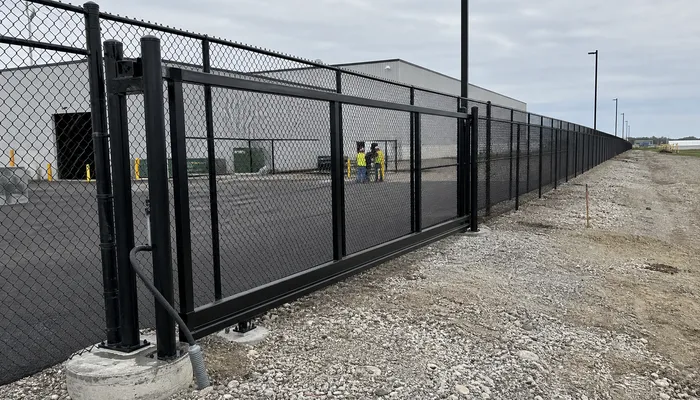
Ask ten Illinois property managers what commercial fence installation really cost, and you will get ten different numbers — and all of them can be correct. A perimeter built around a trailer yard in the southwest suburbs and a perimeter around an office campus in DuPage County may use the same linear footage and still land far apart on price, because material, height, gate hardware, site access, utility locates and municipal review all push the total in different directions. The number that matters is not a statewide average. It is the number attached to your property, your scope and your site conditions.
This guide breaks down what actually goes into a commercial fencing quote in Illinois, why two similar properties can be priced differently in neighboring villages, and what to confirm before you approve anything.
The Illinois Frame: One State, Many Fencing Markets
Illinois is home to an estimated 12.7 million residents, according to Census Reporter’s Illinois profile built on U.S. Census ACS estimates. More relevant for fencing, that population is spread across very different commercial environments: dense industrial corridors, older inner-ring suburbs with tight lots and alley access, and newer suburban commercial districts with larger pads and longer frontages. The Wikipedia entry for Illinois describes the state as a Midwestern anchor with Chicago in the northeast, and that geographic split shows up directly in the work.
A fence around a logistics yard in Cook County is reviewed by one municipality with its own submission process. A retail center in DuPage County is reviewed by another. Neither jurisdiction sets your material cost, but both affect documentation, timeline and how a crew sequences the install. That alone explains part of the gap between two quotes for what looks like the same fence.
The same logic applies from one town to the next. Work planned through a commercial fence company in Alsip, IL, might hinge on trailer circulation, dock protection and right-of-way limits, while a property a few miles away answers to a different plan reviewer and a different set of constraints. Good perimeter planning is never about one city; it is about matching the system to the property in front of you.
What Actually Drives the Cost of Commercial Fence Installation
Before comparing bids, it helps to know what a contractor is actually pricing. In commercial work, these are the variables that move the number most:
- Linear footage and layout. Straight runs are the cheapest geometry. Corners, jogs, angled property lines and tight transitions all add posts, bracing and labor hours.
- Fence height. Height raises material cost and, more importantly, changes wind loading. Taller fences need heavier posts, deeper footings and sometimes engineered details.
- Material and gauge. Chain link, steel, aluminum, wrought iron, vinyl and wood are priced differently per foot before coatings, finishes and hardware enter the picture.
- Post spacing and footings. Illinois frost conditions require footings set below the frost line, and soil type, pavement removal and hand-digging near utilities all add cost.
- Gates and operators. Every gate adds framework and hardware, and an automated gate adds an operator, safety devices, power and controls.
- Removal and disposal. Tearing out an existing fence, cutting concrete and hauling away old posts is real labor and real disposal cost.
- Site access and phasing. A yard that must stay operational means staged installation, temporary protection and crews working around trucks.
- Permits and inspections. Application steps, drawings and inspection scheduling add administrative scope that lean bids often leave out.
The question of what commercial fence installation really cost in Illinois comes down to how many of those boxes a specific property checks. Two sites with the same fence style can diverge simply because one needs pavement removal and the other does not.
Material Choices and How They Move the Budget
Material selection is the most visible cost decision, and in commercial work it is normally driven by function first and appearance second.
Chain Link and Steel: The Industrial Workhorses
Chain link remains the most cost-efficient way to define a large perimeter, which is why it dominates storage yards, utility sites and distribution properties. Gauge, coating and fabric height drive price more than style does, and adding privacy slats or a heavier framework changes both cost and performance. Steel systems sit above chain link in cost and durability, and they are usually chosen where impact resistance or a longer service life matters.
Chain link fencing in Hodgkins, IL, is often specified for trailer storage and equipment yards where visibility, airflow and cost efficiency matter more than decoration — the same reasoning applies to industrial sites across the region.
Aluminum, Wrought Iron and Vinyl: Appearance on a Working Perimeter
Aluminum and ornamental iron systems cost more per foot, but they earn their place on customer-facing frontages, multifamily properties and municipal sites where appearance is part of the requirement. Vinyl delivers a low-maintenance look with fewer finishing steps, though material grade and sun exposure affect how long that look holds. If budget sensitivity is the priority, it is worth reviewing understanding vinyl fence installation costs before assuming the cheapest material produces the cheapest project.
Wood: Character With an Ongoing Maintenance Line Item
Wood fencing suits properties that need screening or a warmer appearance, and it is forgiving on curves and grade changes. The trade-off is maintenance: sealing, repairing and replacing boards on a schedule. In a commercial budget, that recurring cost belongs next to the installation price, not separate from it.
Gates and Access Control: Often the Largest Single Line Item
Owners are frequently surprised that gates cost as much as a long stretch of fence. A drive gate needs a heavier frame, heavier hinges, concrete footings sized for its weight and — once automated — an operator, safety sensors, a control pedestal, and trenched power and low-voltage runs. Add a card reader, keypad, intercom or loop detector and the access-control portion of the budget grows quickly.
Commercial gate installation in Lombard, IL, shows how scope compounds: on a suburban commercial parcel the gate leaf itself may be straightforward, while trenching, power coordination and credential management are what actually drive the schedule and the final invoice.
It also pays to size the gate to real traffic rather than habit. A site running dozens of trucks a day has different requirements than one with a handful of employee vehicles, and the hardware difference is measurable.
Permits, Inspections and Illinois Site Conditions
Illinois administers fence permitting locally. The village, city or county with jurisdiction over the property sets its own submission requirements, review steps and inspection sequence. A code-aware scope names the issuing department up front, accounts for permit and inspection costs, and confirms how the fence interacts with easements, drainage, parking setbacks and visibility at driveways.
Two site conditions deserve budgeting attention from day one. First, footings: frost depths in northern Illinois require posts set deep enough to resist movement through freeze-thaw cycles. Second, utility locates: no responsible crew drills a post hole before underground lines are marked. Both are standard practice, and both add cost that a bare-bones quote may omit. It also helps to review the impact of local regulations on commercial fence installation alongside your own municipality’s requirements.
Reading a Commercial Fence Bid Line by Line
The fastest way to compare two quotes is to confirm they describe the same project. Look for total linear footage and height; post size, spacing and footing depth; fabric or picket specification; concrete quantities; gate count, size and hardware; operator and access-control components; electrical or low-voltage scope; removal and disposal; permit responsibility; and a line for unforeseen subgrade conditions.
A bid that lists three items and a total is not comparable to one that itemizes materials and labor. Until the scope is itemized, any answer to what commercial fence installation really cost is a guess, so what a commercial fence quote should include makes a practical checklist for the second conversation with each contractor.
How These Cost Drivers Play Out in Cook and DuPage County Communities
The communities served here sit across two of the state’s busiest counties. In Cook County, older industrial and commercial areas often mix tight lots with active truck traffic, which puts a premium on staging and on gate placement. In DuPage County, newer commercial districts tend to offer longer frontages and clearer setbacks, which shifts cost toward material quantity rather than site logistics.
Industrial fencing in Palatine, IL, illustrates that tension: a larger suburban footprint usually comes with neighbor-facing sides where screening and appearance matter as much as security, so material choice carries more weight than fence length. Farther southwest, security fence installation in Westmont, IL, on a tighter commercial parcel often comes down to a shorter run, careful gate positioning and how easily crews can work around existing traffic and parking.
Lombard and Westmont sit in DuPage County, while Alsip, Hodgkins and Palatine are Cook County communities — and in practice, that county-level difference shows up in which office reviews plans, how inspections are scheduled and how much documentation a project needs before mobilization.
Frequently Asked Questions About Commercial Fence Cost in Illinois
Is commercial fence installation really cost the same everywhere in Illinois?
No. Permitting, frost-depth footings, site access and labor logistics differ by municipality and by property, so even neighboring villages can produce different totals for similar fence specifications.
What usually causes the biggest gap between two bids?
Scope, not pricing. One bid may exclude removal, footings, gates, operators or permit work, which makes it appear cheaper until those items are added back at the end.
Do commercial fences in Illinois require a permit?
Fence permitting is handled locally, so the requirement depends on the municipality with jurisdiction over the property. Confirm the application process, review steps and inspection sequence with that department before ordering material.
Why do gates cost so much more than an equivalent length of fence?
A gate is a moving structure. It needs a heavier frame, engineered footings and hardware built for daily cycles, and if it is automated it also needs an operator, safety devices and power. Readers and wiring add another layer.
How can a property manager reduce the total without cutting security?
Phase the work. Secure the highest-risk boundary first, use chain link where visibility is an asset, reserve decorative systems for customer-facing elevations, and standardize gate sizes so hardware and replacement parts stay common.
How long does a commercial fence project take in Illinois?
Timeline depends on permit review, material lead times, site access and weather. Scheduling around freeze-thaw periods and confirming delivery dates before mobilization usually prevents the worst delays.
Planning Your Illinois Perimeter Project
Cost conversations get easier once the scope is on paper. Start with your site assessment, confirm which jurisdiction issues the permit, and ask each contractor to itemize the same list. That turns a vague range into a defensible number and makes two competing quotes genuinely comparable.
If your property sits in this part of northern Illinois, the most useful next step is to review the community page that matches your location — whether that is an industrial corridor, a suburban commercial district or a municipal site — so the materials, gates and access-control decisions reflect your actual market rather than a generic estimate.
Ciudades Relacionadas De Esta Región
- Commercial Fence Company Alsip IL en Alsip, IL
- Wood Fence para Hodgkins, IL
- ayuda con Aluminum Fence Installation en Lombard, IL
- servicio de Wrought Iron Fence en Palatine, IL
- Vinyl Fence en Westmont, IL