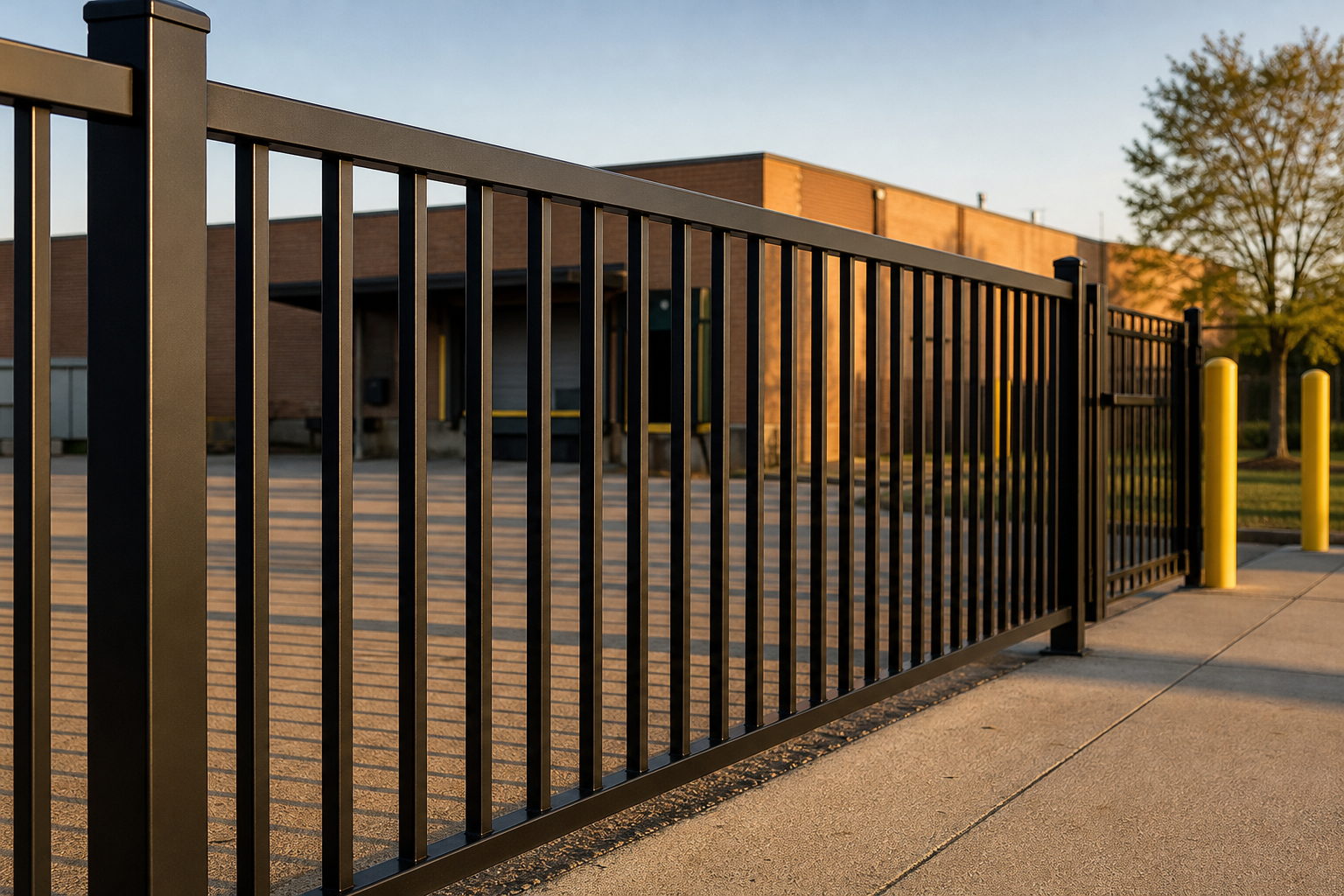
Two bids for the same warehouse or storage yard can look identical on the cover page and differ completely three feet underground. Commercial-grade is not a marketing label — it is a short list of measurable specifications: wire gauge, mesh size, post diameter and spacing, footing depth, coating system, finished height and gate clear opening. Those numbers are what hold a warehouse, storage yard and truck court perimeter straight after years of trailer turns, plow contact and winter road salt.
Wire Gauge and Mesh: Where Residential and Yard-Grade Specs Diverge
A residential chain link run is commonly built with 11.5- or 12.5-gauge wire, 1-7/8 in. line posts and a light top rail. Commercial fencing in Alsip, IL is specified heavier on purpose: 9-gauge or 6-gauge wire, 1-5/8 in., 2 in. or 2-3/8 in. framework, and tighter mesh on runs where someone could reach through with a tool. Heavier wire resists sagging between posts, holds its shape when a plow wing drags the bottom rail, and does not need re-tensioning every few seasons.
Post Spacing and Footings Under Vehicle Load
Post spacing is the spec most often quietly changed between a bid and an install. Light residential runs usually sit at 10 ft with 1-7/8 in. posts; yard and loading-area runs generally tighten to 8 ft spacing with 2-3/8 in. or larger line posts, heavier terminals, and concrete set below the frost line. Gate posts carry the heaviest load on the property, because every vehicle pass and every gate cycle pushes against them. They need a larger diameter, a wider and deeper footing, and a frame sized to the clear opening it spans rather than to whatever an operator can barely move.
Coating Systems and Road-Salt Exposure
Coating decides how long wire and posts survive the local environment. Class 1 galvanized chain link carries roughly 1.2 oz of zinc per square foot; Class 2 carries about 2.0 oz, and hot-dip galvanizing after fabrication protects cut ends and welds better than pre-coated wire. Vinyl-bonded and powder-coated systems add color, cut glare and create a second barrier against chloride tracked out of plowed lots. Where salt spray hits the same bottom rail every season, a heavier zinc coating plus a bonded overcoat is often the difference between a fence that rusts at the ties and one that finishes its service life looking intact. A written quote should name the coating standard, not just say galvanized.
Height Ranges and Gate Openings Sized to the Yard
Commercial fence heights typically start at 6 ft and run to 8, 10 or 12 ft for storage yards, equipment lots and salvage areas, with 8 ft the most common working height. Height is only half the access picture, though; the number that matters operationally is the clear opening of the gate. A single swing gate rarely serves a truck court — cantilever and slide gates sized by clear opening, with frames heavier than the line fence and operators rated by gate weight and daily cycle count, keep an access point usable. Pedestrian gates, double-drive gates and separate inbound and outbound lanes each change what the framework has to carry.
Reading Commercial Fence Quotes Line by Line
Because quotes are rarely written to the same level of detail, set the specs side by side before comparing totals. Ask every bidder to state wire gauge, mesh size, post diameter and spacing, footing depth and diameter, coating standard, finished height, and gate clear opening with operator rating. When a commercial fence company in Alsip, IL will not put those numbers in writing, that bid is not comparable to one that will. A commercial fence contractor in Alsip, IL should also be able to explain how each choice behaves on your specific layout — where a drive aisle turns tight, where a gate cycles fifty times a day, where the pavement is salted hardest — instead of quoting one generic package.
If you are reviewing specs and want a second opinion on what your perimeter actually needs, send a site plan or aerial image along with the current bids through our contact page.