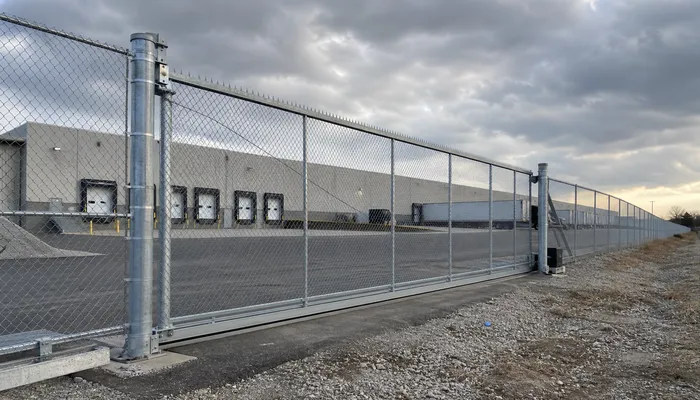
Warehouse and distribution operators across Chicago’s southwest suburbs keep running into the same planning question: how do you define a perimeter that keeps trailers moving at the dock while protecting inventory, equipment and people? In practice, security fencing options for warehouses come down to four decisions — material, height, gate and access-control strategy, and how the fence interacts with the site’s traffic pattern. Get those four right and the perimeter performs for a decade. Get one wrong and you end up rebuilding sections while trucks stage in the yard.
Why the Southwest Suburbs Need a Site-Specific Plan
Illinois is a Midwestern state whose economy runs on freight as much as manufacturing. Chicago — the state’s largest city — anchors a logistics network that reaches well beyond the state line, and the southwest suburbs sit directly on that network. Industrial parks, cross-dock terminals and outdoor storage yards in Will and Cook counties frequently share property lines with residential subdivisions, school districts, retail centers and municipal right-of-way. That adjacency, not the fence itself, is what makes perimeter planning more complicated here than on a greenfield site.
The state’s scale reinforces the point. Census Reporter’s Illinois profile puts the state population at roughly 12.7 million, and the general context for Illinois places Springfield as the capital and Chicago as its largest city. A state that size does not run one fence code; it runs hundreds of municipal and county variations. A layout that works in one industrial park can need real adjustments two towns over, which is why projects here start with the parcel rather than with a catalog.
Security Fencing Options for Warehouses: Material Comparison
Material choice is where most projects either get efficient or get expensive. Each commercial material solves a different problem, and the right answer usually combines two of them on the same property.
- Commercial chain link. The workhorse of industrial perimeters: galvanized or powder-coated, available in heavier gauges and tighter mesh, and the most predictable way to cover long linear runs. It pairs well with privacy slats where a yard faces a public street. For a local example of how it is specified, see commercial chain link fence installation in Frankfort, IL.
- Steel. Heavier structures, tighter sightlines and better resistance to impact at high-traffic entries. Steel is usually the right frame material for sliding and cantilever gates, and for corners where a yard truck can clip a post. Much of the versatility of steel fencing panels comes from how well they handle those concentrated loads.
- Aluminum. Rust-resistant, lighter to handle and often chosen for frontages, employee entrances or office-facing areas where appearance matters as much as the barrier. Aluminum panels keep sightlines open while still reading as a controlled boundary.
- Wrought iron and ornamental steel. Best for visible frontage where the property wants a defined, decorative edge that still looks commercial rather than residential.
- Wood and vinyl. Primarily screening materials. Both soften the view of loading areas, dumpster pads or mechanical yards that face residences, and some municipal codes specifically call for natural-material screening between industrial and residential uses.
Defining the Perimeter Before You Choose Anything
Walking the site is not a formality. Before a single post is set, the plan should map every vehicle entry, pedestrian door, emergency access point, easement and sightline. Trailer turning radii, snow storage areas and dock approach lanes all affect where a fence line can actually run. Utility and drainage easements matter as well — many municipalities prohibit fencing inside them without written consent, and a fence line drawn across a drainage swale creates a maintenance problem that outlives the contractor who installed it.
That walk-through is also where gate strategy gets decided. A site with one monitored entrance needs a very different design from one with four unmonitored drive aisles, and the answers usually come from watching the property operate rather than from a drawing. Projects of this type, such as commercial security fencing and gates serving Lockport, IL, typically start with a survey of existing traffic patterns and a quick review of perimeter security basics before layout decisions are locked.
Gates and Access Control at Dock and Yard Entrances
Gates are the part of the perimeter people touch every day, so they take the most wear and cause the most frustration when they are undersized. Slide and cantilever operators are common where there is no room for a swing arc; swing gates still work well at narrower openings and pedestrian access points. Either way, the surrounding scope has to cover power and data conduit, trenching depth, loop placement and a fallback plan for the rare power interruption during a shift change.
Access control is a separate decision. Keypads, proximity cards, fobs, mobile credentials and license-plate readers all solve the same problem at different costs and with different administrative overhead. The practical question is not which technology is newest, but how many daily entries the system has to process, who manages the credential list, and what happens when someone loses a card at 2 a.m. Matching readers to gate geometry is routine work on automatic gate installation in Orland Park, IL, and it is worth settling before the concrete is poured.
Height, Screening and What Local Codes Actually Regulate
Illinois does not publish one statewide fence height for commercial properties. Each municipality administers height, setbacks, screening and material rules through its own zoning code and permit review, so the rules that most often reshape a warehouse plan are local:
- Maximum height for perimeter fencing, and separate limits when the fence is doubling as required screening between incompatible uses.
- Setback distances from property lines, public right-of-way and required parking areas.
- Restrictions on barbed wire, razor ribbon and electric wire near public ways, alleys and sidewalks.
- Prohibitions on fencing within utility, drainage or parkway areas, and limits inside clear-sight triangles at corners and driveways.
- Material requirements when a fence is serving as landscape screening rather than as a security barrier.
A fence permit is normally required before installation or replacement, and permit review is where those details get confirmed for the specific parcel. In Illinois outside the City of Chicago, excavation for posts and footings also triggers a utility locate request through JULIE before any digging starts. Getting both of those administrative steps into the schedule early is far cheaper than discovering them while materials sit on site.
Keeping the Perimeter Working: Repair, Phasing and Replacement
A perimeter fence is an asset with a maintenance schedule attached. Posts that have taken a hit from a yard truck, gates that no longer close squarely, fabric stretched by impact and finish failures along the bottom rail of a chain link line are the usual early signals. Catching them early keeps a repair small instead of turning it into a section replacement, and for sites tracking long-term cost it pays to compare sustainable perimeter options and lifecycle cost before choosing the lowest bid.
When replacement is the right call, the work rarely has to stop the operation. Perimeter projects are usually phased by elevation — starting with the side that is least active or already failing — so dock traffic and outbound routes stay open, with temporary fencing covering the active edges in the meantime. Crews that handle this kind of staged work include commercial fencing contractors working in Tinley Park, IL.
How Security Fencing Options for Warehouses Differ by Site Type
An outdoor storage yard, a cross-dock distribution center, a cold-storage facility and a small contractor lot do not need the same perimeter. Storage yards prioritize long linear runs, limited entries and low visual access. Cross-dock facilities prioritize gate throughput and driver turnaround. Sites with public-facing frontage often split the design instead: heavy-duty security material facing the yard and rail side, a more finished treatment along the street. That split approach shows up in work such as industrial fencing and perimeter work in University Park, IL, where one property can be answering to two different sets of expectations at once.
Whatever the site type, the sequence for narrowing security fencing options for warehouses stays the same: understand the traffic, confirm what the local code allows, then choose the material and gate package that fits.
Frequently Asked Questions About Warehouse Perimeters
Does a commercial fence need a permit in Illinois?
Yes, in most municipalities. Permits are issued at the city or village level rather than by the state, and submittals usually require a site plan showing the fence line, height, material and gate locations. Requirements vary enough from town to town that it is worth confirming with the local building department before materials are ordered.
Which material is most common for warehouse perimeters?
Commercial chain link remains the most common because it covers long distances efficiently and accepts gates, slats and heavier mesh. Steel and aluminum are usually added at frontages, entries and gate frames rather than used across the entire perimeter.
How long does a commercial perimeter project take?
Timelines depend less on the fencing crew than on permit review, utility locating, material lead times and site access windows. Phased projects that keep the dock open generally take longer in calendar time than a full shutdown, but they avoid operational disruption.
Can a warehouse fence be replaced without shutting down the yard?
In most cases, yes. Work is sequenced by elevation and temporary fencing covers the perimeter while it is open. The real constraint is usually scheduling around receiving hours rather than the installation itself.
How should quotes for security fencing options for warehouses be compared?
Line item by line item. A quote that lists posts, fabric, gates, operators, concrete, conduit, removal of existing material and permit coordination is comparable; a single lump-sum number rarely is. Ask what is excluded before choosing on price alone.
Warehouse and distribution sites in Frankfort, Lockport, Orland Park, Tinley Park and University Park all share one thing: a perimeter only earns its cost when it matches the way the property actually operates. The city pages linked above walk through material, gate and permit considerations for each of those communities, and they are the fastest way to see how the same planning sequence applies to a specific address.