Skip to content
Anyone planning a perimeter for a warehouse, distribution yard, or industrial facility in northern Illinois eventually runs into the same question: how weather affects commercial fence materials over the life of the asset. Across the Fox Valley and the surrounding communities, a fence does not face a single season. It faces wet springs, humid summers, repeated freeze-thaw cycles that work on footings and fabric, and winter wind that pushes on every panel. Choosing a material is therefore a long-term durability decision as much as a security decision.
Why the Illinois Climate Drives Commercial Fence Material Choices
Illinois is a Midwestern state that ranks among the largest in the country by both population and economic output. According to Census Reporter’s Illinois profile, the state is home to roughly 12.7 million people, and the Chicago metropolitan area reaches well into the counties covered here. You can read the broader geographic context on the Illinois overview page.
That range matters because a commercial fence is an outdoor structure with no roof and no climate control. Every post, rail, panel, and gate operator is exposed year-round. A material that performs well in a dry climate can behave differently where the ground freezes and thaws repeatedly, where snow sits against a base plate, and where summer humidity attacks a finish.
For facility managers comparing bids, the practical takeaway is simple: material selection should be matched to exposure, not to a catalog photograph.
Freeze-Thaw Cycles: What They Do to Posts, Rails, and Fabric
Most commercial fence failures that look like a material problem actually started as a site condition. The main pressures to plan around are:
- Soil movement around footings — repeated freezing and thawing can shift posts when footings are undersized for the soil and depth.
- Moisture at the base — water that pools along a post line accelerates corrosion at the most vulnerable point of the fence.
- Drainage — a fence placed across a swale or drainage path holds back water and debris, which stresses both the ground and the structure.
- Wind load — solid panels catch far more wind than open fabric, which changes post spacing and bracing requirements.
- Gate weight — snow and ice add load to gate frames, hinges, and operators.
None of these are exotic problems. They are the ordinary conditions of a northern Illinois perimeter, and they are exactly what a site assessment should address before a quote is finalized.
How Weather Affects Commercial Fence Materials: Chain Link, Steel, and Aluminum
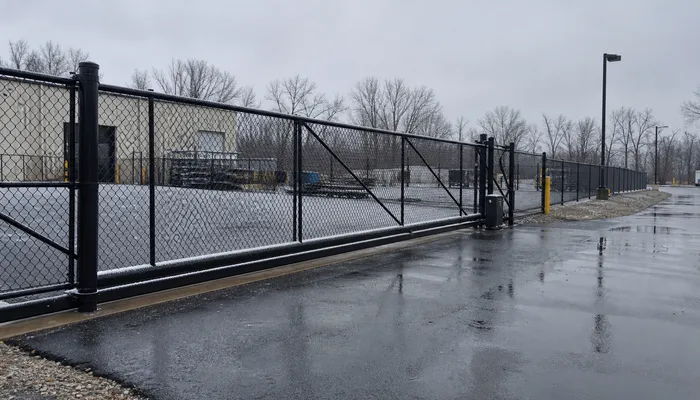
When managers ask how weather affects commercial fence materials, the honest answer is that no single material wins everywhere. Chain link remains the workhorse for yards, storage areas, and industrial perimeters because it is open, cost-effective, and easy to repair. Its weakness in this climate is the finish. Galvanized fabric holds up reasonably well, but cut ends, the bottom of posts, and any field-welded point are where rust begins. Specifying proper coating and correct post-footing detail matters more here than simply choosing a heavier gauge. Projects in the western Fox Valley often start with chain link fence installation in Batavia, IL.
Steel fencing and steel security frames handle impact and repeated load better than most alternatives, which is why they are common around equipment yards and utility compounds. The trade-off is that steel needs a finish strategy — hot-dip galvanizing, powder coating, or both — and that finish has to tolerate winter road salt and standing moisture.
Aluminum resists corrosion without relying on a coating, which makes it a sensible choice for railings, ornamental panels, and lighter perimeter sections where appearance matters. Powder-coated aluminum adds color stability. For a closer technical look, our article on extreme weather resistance of aluminum fences breaks down finish and frame behavior. Commercial properties in the northern part of this group’s coverage often begin with aluminum fence installation in Huntley, IL.
Vinyl, Wood, and Wrought Iron in a Midwest Climate
Vinyl is low-maintenance and does not rust, but cold makes it more brittle, which is why impact protection and correct post spacing matter during winter months. Vinyl fence in Montgomery, IL is often specified for retail and multifamily perimeters where appearance and upkeep drive the decision.
Wood brings privacy and a softer look to commercial frontage, but it is the most moisture-sensitive option. Board movement, grain checking, and rot at ground contact are normal outcomes of a Midwest cycle without proper species selection, treatment, and sealing.
Wrought iron and ornamental iron remain a long-term investment; they hold up structurally for decades when rust is managed. Paint and finish decisions, more than the iron itself, decide how they age under repeated wet and freeze cycles. Our guide to fence materials, colors, and finishes covers how those choices interact.
Cold-Weather Access Control and Gate Hardware
Weather does not only attack the fence — it also attacks the point where vehicles enter. Automated gates add hardware that is sensitive to moisture, frost, and ground movement: operator housings, hinges, rollers, safety loops, and readers all sit in the worst part of the environment. Drainage at the gate pad, a level approach, and weather-rated enclosures are the difference between a gate that works all year and one that needs service every February. For sites that depend on controlled entry, commercial gate installation in McHenry, IL is a common starting point.
Permits, Drainage, and Site Planning Across the Fox Valley
Material performance is only half the equation. Every municipality in this group issues its own fence rules, and those rules frequently overlap with drainage, visibility, and utility concerns. Geneva offers a useful illustration: a fence permit is required before a fence or wall is erected; business and industrial district fences are limited to 8 feet outside visibility triangles; fences inside a visibility triangle may not exceed 3 feet above street grade; and the code requires fences to be designed to resist a horizontal wind pressure of at least 30 pounds per square foot — a direct acknowledgment that wind load is a design input, not an afterthought. Drainage rules apply as well, including clearance requirements where a fence crosses a drainage easement. Reviewing that framework early is part of the commercial fence company in Geneva, IL service scope.
Excavation adds a state-level step too. Outside Chicago, Illinois law requires advance notification to the utility locate service before digging, and JULIE’s excavation guidance should be built into the schedule before any post hole is augered.
Service Coverage Across Kane and McHenry Counties
The communities in this group are spread across two northern Illinois counties along the Fox Valley corridor. Batavia and Geneva sit in Kane County, while Huntley and McHenry sit in McHenry County. Montgomery rounds out the group on the southwestern side of the coverage area. Each community mixes older commercial frontage with newer industrial and logistics development, and the fence requirements inside them reflect that mix.
Practically, that means the same property type can call for different specifications in two neighboring towns. A storage yard in one community may be best served by galvanized chain link with privacy slats, while a facility a few miles away may need a steel frame with an automated gate and access control. The material conversation is regional; the permit conversation is local.
Regional FAQ
Does one fence material work across every city in this group?
No. Chain link, steel, aluminum, vinyl, wood, and wrought iron all perform in northern Illinois, but the best fit depends on the property type, the exposure of the specific fence line, the maintenance budget, and local height and location rules. Comparing two or three materials against the actual site condition is more useful than standardizing on one.
How much does weather actually shorten a commercial fence service life?
Finish quality, footing depth, drainage, and the maintenance schedule influence service life more than any single weather event. A fence built with correct footings, protected cut edges, and clear drainage typically outlasts an identical fence installed without those details.
Do commercial fences need a permit in every Illinois municipality?
Permit requirements vary by city or village. Some municipal codes require a permit for essentially all fence work, while others apply different thresholds. Because the requirement is set locally, it should be confirmed for the specific address before material is ordered.
Is galvanized chain link enough for a commercial perimeter here?
Galvanized chain link is a common and reasonable choice for open perimeters. Where the site sees road salt, standing moisture, or heavy snow accumulation, adding a coating or upgrading post and footing details often makes more difference than increasing wire gauge.
What should a quote request include for a weather-resistant perimeter?
Property type, approximate linear footage, fence height, the materials under consideration, gate locations and whether they need automation, access control needs, drainage or easement concerns, and photos of the current fence line. That information shortens the path from first call to a usable estimate.
How weather affects commercial fence materials is ultimately a question of sequencing: understand the site, choose the material for that exposure, confirm local requirements, and only then price the installation. Property owners and facility managers across Batavia, Geneva, Huntley, McHenry, and Montgomery can review the community pages linked above for local context before requesting a site review.