Skip to content
Fence permit requirements for commercial properties around O’Hare International Airport rarely come from a single rulebook. Illinois sets a baseline for construction safety and utility protection, but the rules that decide fence height, finished side, gate placement and drainage review come from the village that issues the permit. Along this corridor, a distribution yard, a truck terminal and a hotel property can sit only a few miles apart and still answer to genuinely different standards.
Illinois is a Midwestern state of roughly 12.7 million residents, according to American Community Survey data compiled by Census Reporter, and the O’Hare corridor sits at the center of the region’s freight and logistics network. That concentration of warehouses, terminals and service properties is one reason commercial perimeter projects here move through so many different sets of local rules.
Commercial fencing is also reviewed as part of the site, not as a stand-alone product. A code official looks at where the fence sits on the lot, how tall it is, what it is made of, how it affects sight lines and stormwater movement, and whether it stands on the property line or entirely inside the owner’s lot. Getting those answers wrong usually means revised drawings and lost weeks rather than a rejected fence, but the delay is real either way.
Why Fence Permit Requirements for Commercial Properties Change Across the O’Hare Corridor
Illinois does not standardize fence installation at the state level, so each municipality writes its own fence section. Height limits, material restrictions, gauge minimums, finished-side rules and prohibited hardware are all set locally, and they are enforced locally. Because fence permit requirements for commercial properties are handled at the municipal level, a permit set should be written for the specific village where the work happens rather than recycled from a previous project a few towns over.
For a property manager running multiple sites, that has a practical consequence: the same fence specification may need three different versions if the portfolio spans three villages. Our overview of how local regulations shape commercial fence installation covers that pattern in more depth.
The Illinois Baseline: Utility Locates Before Any Excavation
One requirement applies across the entire region regardless of which village issues the permit. Illinois law requires underground utility lines to be located and marked before digging, and JULIE, the Illinois 811 service, handles locate requests outside the City of Chicago. Fence posts, bollards, gate footings and conduit trenches all qualify as excavation.
- Call 811 or (800) 892-0123, or submit a request online through JULIE.
- Submit the locate request at least three days but not more than ten days before planned digging.
- The day the request is made, along with weekends and holidays, does not count toward that window.
On a commercial perimeter project, the locate ticket usually needs to be current before crews set the first post, which is one more reason to sequence permits and locates together instead of treating them as separate tasks.
Wood Dale’s Commercial Fence Code as a Working Example
Wood Dale offers one of the clearest illustrations of how a village handles nonresidential fencing. The Unified Development Code, Sec. 17.3010, requires a permit issued by the Development Administrator to erect or alter any fence in the city. Beyond the permit itself, the fence regulations cover height, placement, materials and visibility.
- Height in nonresidential districts. Decorative and privacy fences up to eight feet are allowed in the C-1, C-2, C-2a, C-3 and I-1 districts and for nonresidential uses in other districts, when located at or behind the line extending from the front wall and in rear and side yards only.
- Low decorative fences. Decorative fences up to three feet above ground level are allowed in any yard of any zoning district.
- Lot and orientation rules. The fence must sit entirely on the lot of the property owner building it, and the finished side must face out from that property.
- Drainage. A fence may not be built or maintained in a way that obstructs, inhibits or otherwise alters overland surface drainage across an adjoining lot.
- Visibility and sight triangles. Fences are prohibited inside the sight triangle described in the UDC, and any fence or appurtenance that impairs visibility for people using streets, sidewalks or driveways is prohibited.
Wood Dale also lists specific prohibitions that shape security planning: spikes, glass, protruding nails and other sharp material; chain link with barbed ends up; fencing built of less than 9-gauge wire; electric fences or fences charged with current; and barbed wire or razor wire, with a single industrial exception where barbed wire is installed at least six feet above existing grade and extends inward of the property.
Permit questions for that village go to the Community Development Department at (630) 766-5133 or permits@wooddale.com. For teams scoping work there, our page on commercial fence installation in Wood Dale, IL walks through the site-specific details.
Where Franklin Park, Northlake, Schiller Park and Itasca Fit In
The rest of the group splits across two counties. Franklin Park, Northlake and Schiller Park sit in Leyden Township in Cook County, while Itasca and Wood Dale fall in Addison Township in DuPage County. The county line does not set fence rules, the village does, but it does change which offices, review staff and inspection schedules a project touches.
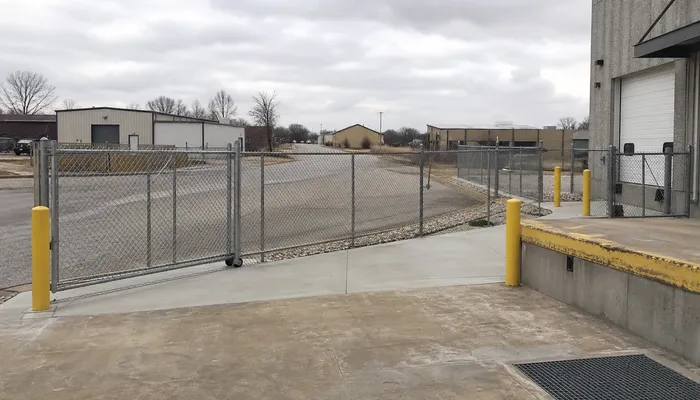
Franklin Park is heavily industrial, with rail-adjacent sites and loading areas where chain link and steel perimeter systems do most of the work. A chain link fence installation for Franklin Park, IL project usually needs the fence line coordinated with existing pavement, dock aprons and rail setbacks before drawings are submitted.
Northlake mixes manufacturing, distribution and commercial frontage along major arterials, which makes gate placement and driveway sight lines a common review point. Steel fence and security fencing in Northlake, IL often has to balance a hardening goal with keeping clear visibility for trucks turning into the property.
Schiller Park sits closest to the airport itself, with hotel, parking and service properties that are visible from the street. Repair and replacement work there tends to move quickly once the fence line and finished-side orientation match what the village already has on file, which is the focus of our notes on commercial fence repair in Schiller Park, IL.
Itasca carries a different mix, with office and light industrial properties near the expressways and the rail line. Material selection tends to matter more there, so aluminum and vinyl fence options in Itasca, IL are frequently weighed against steel and chain link alternatives during the planning stage.
Fence Materials and the Details Reviewers Ask About
Commercial fence permits are typically approved or questioned on five details: height, material, gauge or thickness, post spacing and finish. Chain link remains the most common perimeter material on industrial sites, and wire gauge is a specification some villages regulate outright. Wood Dale, for example, prohibits fencing built of less than 9-gauge wire. Steel and wrought iron systems raise questions about corrosion protection and whether a finish is factory-applied, while aluminum and vinyl generally move through review quickly in commercial settings because they resist rust and need less maintenance, though they still have to meet the height and placement rules for the district.
Wood fencing appears less often on industrial perimeters and more often on commercial frontage, screening and mixed-use properties. When it is used, drainage, finished-side orientation and long-term maintenance tend to be the details that draw comments.
If you are comparing finishes before submitting drawings, the breakdown of galvanized, powder-coated and anodized fence finishes is a useful reference for specifying a coating that matches the review comments you are likely to receive.
Gates, Automated Operators and Access Control
Gate openings are where fence permits and access-control planning meet. A slide or swing gate changes the fence line, the setback from the right-of-way and, in some cases, the sight triangle at a driveway. Automated operators add power and conduit runs, which in turn trigger utility locates and sometimes an electrical review separate from the fence permit itself.
Emergency access is worth confirming early. Fire lanes, turning radii for service vehicles and the ability of emergency personnel to enter the site are often handled by a different reviewer than the one approving fence height, and late changes to gate width or operator placement are one of the most common causes of rework on a commercial perimeter project.
Construction Sites and Temporary Fencing
Construction fencing is regulated separately from permanent perimeter fencing. In Wood Dale, the building regulations require a six-foot chain link construction fence on sites determined unsafe, for example where excavations reach two feet or deeper, where buildings are unsecured, or where work has been delayed for an extended period. The same section requires the site to be enclosed, locked or otherwise secured when no work is occurring, and the fence to be maintained in good condition.
Other villages in the group set their own construction-fence expectations, and those requirements can shift between the demolition phase and the build-out phase of the same project, so temporary fencing is worth confirming at each stage rather than only at the start.
A Practical Permit Sequence for O’Hare-Area Commercial Fence Projects
- Confirm the zoning district and the fence rules that apply to it, including any nonresidential overlay.
- Prepare a plot plan showing the fence line, gates, easements and distance to property lines.
- Specify height, material, gauge, post spacing and finish on the drawings.
- Check sight triangles at every driveway and intersection corner.
- Confirm the fence will not alter overland drainage across adjoining lots.
- Submit the permit application and pay any applicable fees.
- Request utility locates through JULIE before excavation begins.
- Schedule inspections at the points the village requires and keep approved drawings on site.
Budget impact is worth flagging early. Redesigns caused by height, gauge or gate placement add both time and cost, and they are the same variables that drive pricing on a commercial fence project. Our breakdown of what shapes commercial fencing cost covers how those factors stack up, even for projects outside that specific service area.
Frequently Asked Questions
Do fence permit requirements for commercial properties differ from one O’Hare suburb to another?
Yes. Each village writes and enforces its own fence regulations, so height limits, material restrictions and permit submittals can differ even between neighboring towns in the same county. The safest approach is to confirm the rules with the specific municipality before finalizing drawings.
Does a Commercial Fence Always Need a Permit?
In many villages, yes, and that includes alterations to an existing fence rather than only new construction. Wood Dale, for instance, requires a permit issued by the Development Administrator to erect or alter any fence. Even where a repair or replacement matches an existing approved fence, the scope may still need review, so it is worth asking the building or community development department directly.
Can Barbed Wire Be Used on a Commercial Perimeter Near O’Hare?
It is restricted across most of the region. Wood Dale prohibits barbed wire and razor wire generally, with one industrial exception: barbed wire installed at least six feet above existing grade and extending inward of the property. Because the rules vary by village, barbed wire should be confirmed with the local code before it appears on a specification sheet.
How Far Ahead Should Utility Locates Be Requested?
JULIE, the Illinois 811 service, asks for locate requests at least three days but not more than ten days before digging, and the request day, weekends and holidays do not count. That timing is set by the locate service rather than the village, so it applies to construction fencing and permanent fence work alike.
What Fence Height Is Typical for Nonresidential Properties in the O’Hare Area?
Heights vary by district and by village. As one example, Wood Dale allows decorative and privacy fences up to eight feet in its commercial and industrial districts when they sit at or behind the front wall line in rear and side yards, and decorative fences up to three feet in any yard. Anything beyond what a district allows generally points to a variance request rather than a straightforward permit.
Who Do I Contact About a Permit in a Specific Village?
Start with the building or community development department for that municipality, since applications, submittals and inspections are handled locally. Confirm the current zoning district, easements, drainage expectations and sight-triangle limits before submitting final height and placement details.
Commercial fence permits near O’Hare reward planning more than speed. Franklin Park, Itasca, Northlake, Schiller Park and Wood Dale each review fencing against their own code, and the details that get questioned, from height and wire gauge to finished-side orientation and gate placement, are the same details that shape what a perimeter costs and how long it holds up. Start with the village where the property sits, confirm the rules on paper, and build the construction schedule around permits and utility locates rather than adjusting it after the fact.