Skip to content
Choosing a commercial fence contractor in Will County is less about finding the lowest bid and more about matching a perimeter system to the way a property actually operates. Will County covers a broad band of the southwestern Chicago metro, and the property types inside it range from industrial yards and warehouse sites to retail frontage, municipal facilities, schools and multi-phase developments. Each of those puts different demands on fencing, gates and access control. This guide walks through what to ask, what to compare and how the region’s cities differ, so a facility manager or business owner can enter a quote conversation with the right questions already written down.
Illinois is the sixth-most populous state in the country and carries one of the largest state economies, with Chicago anchoring the northeast and a wide mix of industrial and commercial activity spreading outward from there. The Census Reporter profile for Illinois gives a useful picture of the size of that market, and the state overview on Wikipedia covers the geography that shapes how projects move. For Will County, the practical takeaway is simpler: fencing here is a working tool, not a decorative afterthought.
What a Commercial Fence Contractor in Will County Handles
The scope of a commercial fencing project usually stretches well beyond installing a fence line. A contractor working across Will County is typically asked to define a perimeter, protect equipment and inventory, control which vehicles use which gate, separate pedestrian and truck traffic, screen a yard from a neighboring property, or secure a site that is still under construction.
That work breaks down into a few recurring pieces:
- Site assessment — walking the property, measuring linear footage, and noting grade changes, drainage, easements and existing utilities.
- Material selection — matching chain link, steel, aluminum, wrought iron, vinyl or wood to the property type, expected abuse and maintenance capacity.
- Gates and access control — swing, slide or cantilever gates paired with operators, keypads, card readers or loop detection.
- Code-aware planning — checking height limits, setbacks and permit steps before materials are ordered.
- Repair and phased replacement — restoring damaged sections or rebuilding a perimeter in stages while operations continue.
A reliable contractor should be able to talk through all five without being prompted, and should be comfortable saying which parts of a project are straightforward and which are not.
Material Choices That Match the Property
Material selection is where commercial and residential fencing part ways most clearly. A retail pad may want the visual weight of ornamental iron or aluminum. A storage yard almost always wants chain link with a heavier gauge and tighter mesh. A manufacturing site may need steel panels that can absorb an impact without deforming beyond repair.
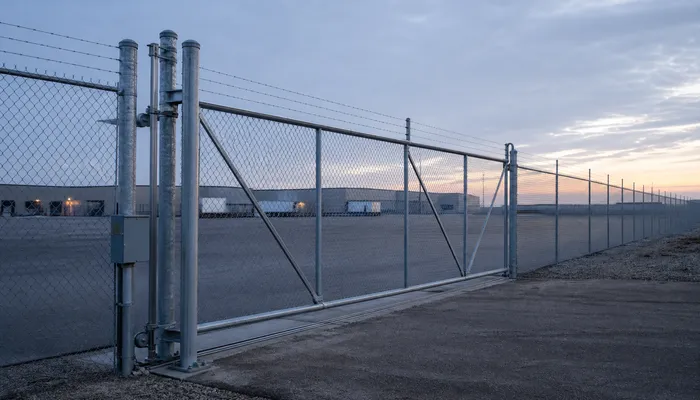
For open industrial and logistics properties, chain link remains the workhorse because it installs quickly, repairs easily in sections, and works with barbed wire, privacy slats or screen mesh. If you are pricing chain link fence installation in Romeoville, IL, ask what wire gauge, what coating and what post spacing the quote assumes. Those three details move the number more than most buyers expect.
Aluminum and wrought iron suit properties where appearance is part of the presentation: professional offices, main entrances, and frontage the public actually sees. Vinyl and wood tend to appear where screening or architectural consistency matters more than impact resistance, such as multifamily communities, hospitality properties and some institutional campuses.
Security Fencing and Access Control for Industrial Sites
Access control is where perimeter decisions get expensive if they are made late. A fence line drawn without thinking about gate placement often forces a redesign once a truck-turning radius or a fire lane is measured. The better sequence is to map traffic first: how many vehicles enter per day, which ones need after-hours access, where drivers wait, and how deliveries are separated from employee parking.
At larger sites that planning usually leads to automated gates with readers or keypads, combined with fencing that resists climbing and cutting. For properties that move freight regularly, coordinating security fencing and gate systems in Joliet, IL around operating hours is often the difference between a project that runs cleanly and one that disrupts the dock schedule for weeks.
It is worth being realistic about what a fence does. A well-specified perimeter improves control, defines boundaries and raises the effort required for unauthorized access. It does not remove risk on its own, and lighting, camera coverage and gate procedures matter alongside the fence.
Permits, Codes and Project Coordination
Fencing rules in Illinois are largely set at the local level, which means a project in one Will County municipality may face height limits, setback distances or material restrictions that do not apply a few miles away. Some sites also span more than one jurisdiction, which adds coordination work before any material is ordered.
A contractor should be able to tell you which office issues the permit, what the application typically requires, and whether a survey or site plan is needed. If a quote arrives with no mention of permits at all, that is a question worth asking before signing anything. For projects that involve both municipal review and ongoing operations, commercial fencing projects in Plainfield, IL often benefit from front-loading the paperwork rather than treating it as a post-contract task.
Two existing guides are useful companion reading here. The Impact of Local Regulations on Commercial Fence Installation explains how local codes shape design and winter performance, and Certificates of Insurance for Commercial Fencing covers the documentation you should collect before crews arrive on site.
Evaluating Bids From a Commercial Fence Contractor in Will County
Quotes for the same fence line can vary widely, and the difference is rarely just margin. Look for line items covering demolition and disposal of existing fencing, post depth and concrete, gate hardware, access control devices, restoration of turf or pavement, and any required inspections.
A few checks separate a solid proposal from a thin one:
- Is the scope written, or implied? Vague quotes create change orders.
- Are materials specified by gauge, coating and dimensions? Chain link alone says nothing about lifespan.
- Who handles permits and inspections? Confirm this in writing before work starts.
- Is the schedule tied to your operating hours? Loading docks and parking lots have constraints.
- What does the warranty actually cover? Fence, gate, operator and access control are usually covered separately.
The questions to ask before hiring a commercial fence company are worth reviewing before the second round of bids, because they tend to surface differences that a price sheet hides.
Repairs, Maintenance and Multi-Phase Work
Not every project starts from bare ground. Vehicle strikes, storm damage, gate operator failures and simple age push many property managers into repair mode rather than replacement mode. A contractor who can assess whether a damaged run should be patched or rebuilt saves money over a full replacement that was never necessary.
For sites that cannot shut down, phased work is the practical answer: replace one exposure of the perimeter at a time, keep gates operational, and stage materials so they do not block circulation. Planning commercial gate installation in New Lenox, IL around an active schedule is a good example of where sequencing matters more than raw speed.
Maintenance also deserves a place in the original scope. A simple annual inspection routine that checks post stability, gate alignment, operator sensors and coating wear catches most problems while they are still inexpensive to fix.
What Changes From One City to the Next
The cities in this group share a county and a regional market, but they are not interchangeable. Joliet is by far the largest, with an estimated population of about 149,800, and it serves as the Will County seat. Bolingbrook follows as the county’s second-largest municipality at roughly 73,800 residents, and it stretches across both Will and DuPage counties, which occasionally complicates which office handles a permit. Romeoville, with roughly 41,000 residents, sits between Bolingbrook and Joliet near the interstate corridors. Plainfield, around 45,700 residents, also crosses a county line into Kendall. New Lenox is the most compact of the group, with roughly 27,500 residents.
Those differences shape how projects are scoped. A large multi-building site usually calls for a phased approach, while a smaller single-parcel property may only need one exposure replaced at a time. For businesses that want a sense of how the county’s property mix translates into real installations, commercial fence installation in Bolingbrook, IL is a reasonable starting point, since the range of property types there touches most of the categories a regional contractor encounters.
Across the region, projects that follow a consistent path — assessment, material specification, coordinated installation and final review — are the ones that hold up over time. That consistent path is what the Industrial Fence Compliance Standard™ is meant to describe.
Questions Businesses Ask About Will County Fencing
Does one contractor cover all of Will County?
Coverage varies by company. Will County stretches from Bolingbrook and Romeoville in the north to Joliet, Plainfield and New Lenox further south, and a contractor with genuine regional coverage should be able to describe how it handles travel, staging and scheduling across those distances.
How much does commercial fencing cost in this region?
Cost depends on linear footage, height, material, gate count, access control, site conditions and permit requirements. Rather than quoting a single number, ask for a range tied to your material choice and confirm what sits outside that range.
Do commercial fence projects need permits in Illinois?
Fencing is generally regulated at the municipal level in Illinois, so requirements differ from city to city. A contractor should be able to identify the issuing office and explain what the application typically needs.
Which fence material works best on an industrial property?
Chain link and steel dominate industrial applications because they handle impact and can be repaired in sections. Aluminum and wrought iron are usually chosen where visibility and appearance carry more weight.
Can a fence be replaced while the property stays open?
Yes, in most cases. Phased replacement works when the contractor sequences work by exposure and keeps at least one access point functional throughout the project.
Is temporary fencing available for construction sites?
Yes. Temporary construction fencing is commonly used to secure active sites, control access and separate public areas from work zones during multi-phase projects.
If you are comparing options across the region, the individual city pages are the fastest way to see how coverage, property types and project experience line up. Bolingbrook, Joliet, New Lenox, Plainfield and Romeoville each have their own page covering local commercial fencing work. Start with the city closest to your site, then bring the details — property type, approximate linear footage, gate needs and timeline — into the first conversation.