Skip to content
Fence zoning rules for North Shore businesses rarely come from a single rulebook. Illinois sets broad baseline expectations for construction, but the practical limits on fence height, setbacks, material choice and gate placement come from the municipality that issues the permit. Along this lakefront corridor, a project team can be answering to a Cook County village on one site and a Lake County city on the next, and the two are not reading from the same page.
That split is the most common source of rework for property managers, general contractors and business owners working north of Chicago. A perimeter that is perfectly reasonable on one side of a municipal boundary can need a variance a few miles away. Knowing who actually controls what, and which documents the reviewer wants to see, keeps a commercial fencing project on schedule instead of circling the plan review desk.
Who Actually Enforces Commercial Fence Rules in Illinois
Illinois is the sixth-most populous state in the country and carries the fifth-largest GDP, as described in the Wikipedia overview of Illinois. That scale matters for fencing projects: commercial property here operates inside a system where authority is split between the state and more than a thousand units of local government. State building standards address structural and life-safety concerns. Zoning is local. Height limits, setbacks, corner visibility triangles, screening requirements and approved materials are set by ordinance in each individual city or village.
The practical consequence is that no single document functions as an Illinois commercial fence code. State standards set a floor. The ordinance attached to your parcel sets the ceiling. Two neighboring facilities with the same chain link specification can end up with different approved heights depending on which side of a boundary line they sit.
Why Fence Zoning Rules for North Shore Businesses Are Not One Set of Rules
The communities in this group sit inside two counties, and each municipality inside them writes its own ordinance. Evanston is a Cook County city on Lake Michigan, and its commercial districts mix retail, institutional and multifamily uses within a few blocks. Reviewers there tend to look at a fence as one part of a larger site picture, so screening, refuse enclosures and pedestrian routes come up early. Owners working through commercial fence installation planning in Evanston, IL should expect to describe how the perimeter interacts with parking and walkways, not just how tall it is.
Skokie is also in Cook County and sits roughly 15 miles north of the Loop, with a street grid that ties directly into Chicago’s. That continuity can be misleading. A perimeter design that reads as ordinary in Chicago may still need adjustment under Skokie’s own ordinance, particularly along frontages that face residential blocks. For properties replacing worn mesh or updating an older enclosure, chain link fencing upgrades for Skokie, IL usually start with confirming the maximum permitted height along each property line rather than a single overall number.
Gurnee is a Lake County village on the Waukegan border, and its commercial character leans toward retail, hospitality and large parking fields. On those parcels, parking lot perimeters, loading zones and trash enclosures frequently share one set of review comments, which means a fence plan can be approved or delayed based on screening language elsewhere in the ordinance. Getting security fence scoping for Gurnee, IL started early helps avoid a design that satisfies a security goal but misses the village’s screening expectations.
Waukegan is the Lake County seat and the largest city in this group, with a working waterfront and a long industrial history confirmed by OpenStreetMap geographic data for Waukegan. Access control carries more weight here than on a small commercial parcel, because many sites have multiple entrances, delivery traffic and after-hours entry points that reviewers examine as one system. When perimeter and entry hardware are planned together, automated gate and access control work in Waukegan, IL tends to move through review more smoothly than a fence permit followed by a separate gate submission.
What Municipal Review Usually Examines
While the numbers differ, the categories of review are fairly consistent across the region. A plan set that addresses each of these upfront tends to generate fewer revision cycles:
- Height along each property line, and whether the parcel sits on a corner
- Setback distance from the property line and from the public right-of-way
- Materials and finishes permitted in the applicable zoning district
- Screening requirements for dumpsters, utility pads and mechanical equipment
- Gate placement, vehicle stacking and emergency vehicular access
- Signage mounted on or attached to the fence
These categories recur, but the thresholds do not. Zoning regulations for commercial fencing vary by municipality, and the only reliable answer comes from the building department handling your address. A licensed contractor can help navigate local permit processes, but the confirming call is always the local one.
Because permit procedure and zoning substance are two different conversations, it helps to separate them. The general workflow for submissions, inspections and sign-offs is covered in our overview of Commercial Fence Permits in Chicago: What Businesses Need to Know, which is useful as a procedural companion to the municipal ordinance itself.
Matching Materials to What the Ordinance Allows
Material selection is not purely an aesthetic or budget decision in this region. Some ordinances restrict fence type by district or by frontage, and some limit solid fencing along certain corridors to preserve sight lines. Chain link remains the workhorse around service yards, storage areas and utility compounds. Steel and ornamental iron show up where durability and appearance both carry weight. Aluminum and vinyl appear more often on mixed-use and retail frontage. Wood is frequently the most restricted option near commercial corridors, even though it performs well in enclosed yards.
Add-ons get reviewed too. Privacy slats, windscreen, barbed wire alternatives, anti-climb toppings and signage all change how a fence is classified. Signage in particular is easy to overlook: what is printed on the fabric or mounted to the rail can fall under a separate rule than the fence itself, a distinction we break down in Effective Fence Signage for Businesses.
Setbacks, Gates and Emergency Access
Setbacks are where North Shore projects most often get caught. A front yard, side yard and rear yard each carry their own measurement, and corner lots add a visibility triangle that can rule out a solid panel near the intersection. Utility easements along a rear property line can also push a fence line inward, which changes post spacing, gate swing and the amount of material the job actually requires.
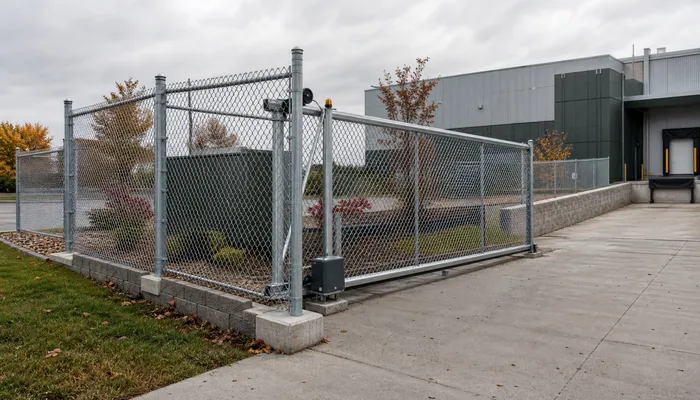
Gates introduce a second layer. Automated gate systems bring power routing, safe closing behaviour, emergency access and vehicle stacking into the review conversation, and fire access lanes are commonly checked against the gate plan. Treating door hardware and perimeter fencing as one scope, rather than two sequential projects, is usually the difference between one approval cycle and three.
Working With a Commercial Fence Contractor Through the Approval Process
A code-aware commercial fence contractor does more than install posts and fabric. The useful part of the process happens before fabrication: a site assessment that documents property lines, grade changes, existing utilities, drainage patterns and traffic flow, followed by a plan set that matches the material specification to the ordinance language for that specific parcel.
We apply an Industrial Fence Compliance Standard™ to that sequence, meaning the perimeter scope, gate scope and permit documentation are developed together and reviewed against the site conditions before installation begins. The goal is not paperwork for its own sake. It is to avoid discovering an easement conflict, a missing screening element or an under-specified post after concrete has already been poured.
Fence Zoning Questions North Shore Property Managers Ask
Do fence zoning rules for North Shore businesses differ from city to city?
Yes. Height limits, setbacks, permitted materials and screening language are set by each municipality’s zoning ordinance, so Evanston, Skokie, Gurnee and Waukegan each apply their own standards even though they sit within a few miles of one another.
Does the state or the city approve a commercial fence?
The municipality issues the zoning and building approvals for the fence itself. State-level standards establish minimum safety expectations, but the height, location and material rules that govern your parcel come from the local code and the local reviewer.
Which county handles a fence permit along this corridor?
Evanston and Skokie fall in Cook County, while Gurnee and Waukegan sit in Lake County. County boundaries are useful for orientation, but the permit itself is normally administered by the city or village where the property is located.
What should a business prepare before requesting a fence quote?
Approximate linear footage, the property survey or plat, nearest cross street, fence type or material preference, gate and access control needs, photos of the existing perimeter and any known easements or drainage issues. That combination gives a contractor enough to scope the work and flag likely review items.
Can a fence project be phased while the site stays operational?
Phasing is common on occupied commercial sites, but the sequence should be planned alongside the permit drawings so temporary barriers, temporary gates and staging areas are accounted for in the approved scope.
How do I confirm the rules for my specific address?
Start with the zoning district shown on your parcel’s record, then request the fence-related ordinance sections and the current submittal checklist from the local building department. Those two documents answer most height and setback questions before a contractor ever visits the site.
Next Steps for a North Shore Commercial Perimeter
Zoning is the first filter a commercial fence project has to pass, and it is where the most time is saved or lost. Reading the ordinance for your district, confirming the submittal requirements with the local building department and bringing a contractor in early gives you a realistic scope, a defensible budget and a plan set that holds up in review. The community pages for Evanston, Gurnee, Skokie and Waukegan cover local service details and project considerations for each area, and our team can walk a site, document conditions and outline a scope before anything is ordered.
Ready to move from ordinance language to an actual scope? Request a commercial fence site review with your property address, approximate linear footage and any gate or access control requirements, and we will follow up with the questions that matter for your district.