 Skip to content

Repair or Replace a Commercial Fence After a Vehicle Strike
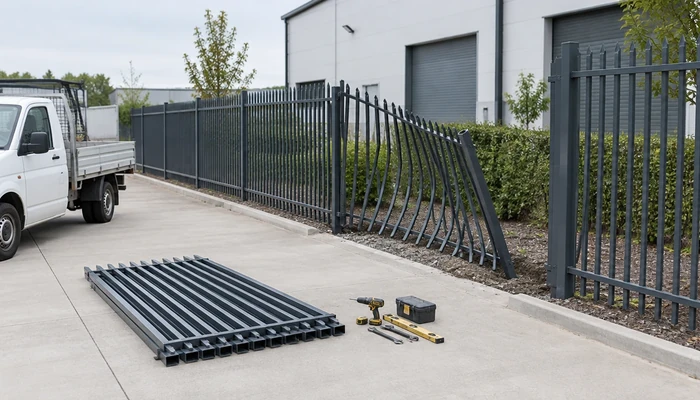
A vehicle strike can leave a commercial fence leaning, broken, or scattered across a driveway. The damage may look limited to one panel, but the impact can also loosen posts, crack concrete footings, bend a gate, or weaken nearby sections. That makes the first decision more important than choosing a replacement part: is the area safe to use?
Deciding whether to repair or replace a commercial fence after a vehicle strike depends on the force and direction of impact, the fence material, the condition of its supports, and the role the fence plays in site security. A quick patch may be suitable for isolated damage, while hidden structural movement can make a small repair unreliable.
This guide walks property managers and business owners through immediate safety steps, a practical damage assessment, material-specific repair considerations, and the factors that affect cost and timing. It also explains what to document for an insurer and when to involve a qualified fence professional. In the Chicago, Illinois area, freeze-thaw cycles and winter ground conditions can make foundation checks especially important after an impact.
Start with safety, not the repair decision
A struck fence can contain sharp metal, splintered wood, loose hardware, or unstable sections. A gate may also be out of alignment and swing unexpectedly. Until the area has been checked, keep people, vehicles, and equipment away from the damaged span.
- Set a safe perimeter. Use cones, barriers, or staff direction to keep people from walking or driving beside unstable parts. Do not lean on a damaged fence or try to pull it upright.
- Look for immediate hazards from a distance. Watch for fallen wires, exposed sharp edges, hanging panels, obstructed exits, and damaged electrical equipment near the fence.
- Protect access points. If a perimeter opening creates a security concern, use a temporary barrier or staffed access control that does not add a new hazard.
- Contact emergency services when needed. If anyone is injured, a vehicle is blocking a public way, or there is an immediate danger, contact the appropriate emergency responders.
- Arrange a professional assessment for structural damage. Avoid climbing, cutting, lifting, or dismantling parts that may be under tension or supporting other sections.
A temporary barrier is not a substitute for a safe, functioning perimeter. Make sure it does not block required exits, accessible routes, fire access, or vehicle sightlines. For sites that rely on layered safeguards, the broader overview of perimeter security can help frame how a fence fits into access control and site operations.
What a vehicle impact can damage beyond the visible panel
Fence damage is not always limited to the spot where a bumper or vehicle body made contact. Impact force travels through connected rails, mesh, posts, gate hardware, and the soil or concrete supporting them. A fence may appear upright while a post has shifted below grade or a connection has started to pull apart.
Visible damage
- Bent, twisted, cracked, or detached panels and rails
- Broken pickets, boards, mesh, ties, brackets, or fasteners
- Posts that lean, buckle, split, or show fresh movement at the base
- Damaged gate leaves, hinges, latches, operators, or tracks
- Scrapes, impact marks, displaced caps, and exposed edges
Less obvious damage
- Cracked or loosened concrete around a post
- Soil that has shifted, settled, or pulled away from a footing
- Stress or distortion in connected sections beyond the contact point
- Gate misalignment that appears only when the gate opens or closes
- Damage to buried utilities, lighting, access equipment, or nearby paving
Do not assume an undamaged-looking section is safe simply because it remains upright. A fence professional can check the affected span and the connections around it, especially where a damaged post supports a long run or a gate. This is one reason the decision to repair or replace a commercial fence after a vehicle strike should follow an inspection rather than a visual guess.
Document the incident before damaged parts are moved
Good documentation helps a property manager coordinate repairs, explain the scope to an insurer, and keep a record for future maintenance. Take photos only from a safe position. Do not delay urgent steps to preserve evidence if people or property remain at risk.
- Record the date, time, and location. Note the affected fence line, nearby entrance, and relevant property area.
- Photograph the overall scene. Capture the damaged section in relation to the driveway, building, gate, and adjacent fence runs.
- Take close-ups of visible damage. Photograph bent posts, broken connections, cracked footings, displaced soil, and damaged gate hardware.
- Write down what is known. Include witness details, vehicle or incident information available to the property, and any immediate actions taken.
- Keep relevant records. Save repair estimates, inspection notes, receipts for temporary safety measures, and messages with the insurer or responsible parties.
- Record operational effects. Note blocked access, temporary closures, security changes, and whether the gate or fence can still be used safely.
Policies and claim requirements differ, so check directly with the insurer before authorizing non-urgent work that could affect a claim. Emergency measures to protect people and property may still be needed. Keep receipts and photos of temporary measures, and ask the insurer what documentation it requires.
How to assess the full extent of fence damage
A useful assessment looks at function as well as appearance. The key question is not simply whether a panel is bent; it is whether the fence can still perform its intended job without creating a hazard or leaving a weak point in the boundary.
Check the fence’s purpose
List what the damaged section is expected to do. It may separate vehicles from a pedestrian area, control access, secure equipment, mark a property boundary, provide screening, or protect a loading zone. A repair that restores appearance but not the required function may not be adequate.
Trace the impact path
Identify the point of contact, then follow connected rails, mesh, posts, and gate components in both directions. Look for bends, loosened fasteners, new gaps, and changes in alignment. The distance to inspect depends on the impact and the fence design; there is no universal number of panels that can be assumed unaffected.
Check supports and ground conditions
Posts transfer loads into the ground. Signs of movement around the base, cracked concrete, water gaps, or fresh soil disturbance deserve attention. In cold climates, existing frost movement or softened ground can complicate the assessment. Do not excavate around a post until buried utilities have been considered and the work area is safe.
Test gates only when it is safe
A gate that looks intact may bind, sag, fail to latch, or put strain on a damaged post. Do not force a gate through resistance or operate a powered gate if its track, operator, wiring, or safety equipment may be damaged. Arrange a qualified assessment when operation is uncertain.
For broader decisions about planning and compliance, see the site’s discussion of how local regulations can affect commercial fence projects. The specific requirements depend on the property, jurisdiction, fence location, and any work proposed.
Repair versus replacement: a practical comparison
Repair is often reasonable when the damage is limited, the supporting structure remains sound, and a compatible part can restore the fence’s intended function. Replacement becomes more likely when damage affects multiple structural elements, the fence cannot be matched reliably, or repeated repairs would leave an inconsistent or weak boundary.
| Consideration | Repair may fit when | Replacement may fit when |
|---|---|---|
| Extent of damage | Damage is isolated and adjacent parts remain stable | Several posts, rails, panels, or connections are damaged |
| Support condition | Posts and footings remain secure and aligned | Posts have shifted, buckled, or lost reliable support |
| Material match | Compatible parts and finishes are available | Matching parts are unavailable or the existing fence is deteriorated |
| Site function | A targeted repair can restore the needed barrier or access control | A repair would leave an unsafe gap or fail the site’s operational needs |
| Long-term value | Repair is durable and proportionate to the remaining fence life | Repeated repairs are likely or a broader upgrade is already needed |
This table is a starting point, not a substitute for inspection. A single damaged post can matter more than several bent pickets if it supports a gate or carries loads across a long run. Conversely, a visibly damaged panel may be replaceable without disturbing a sound foundation.
When a targeted repair is a reasonable option
A localized repair may be a good fit when the impact has not compromised the supporting structure. Examples include replacing a broken infill panel, replacing damaged fasteners, or repairing a short section of mesh when the terminal posts and rails remain secure.
Before approving a repair, confirm that the proposed scope addresses the cause and extent of the damage. Ask whether the contractor will check nearby connections and posts, whether replacement parts will match the existing material, and whether the gate or access system needs separate attention.
- The damage is limited to a clearly defined area.
- Posts, footings, and adjacent sections show no signs of movement.
- Replacement components can be connected correctly to the existing fence.
- The repaired fence will still meet the site’s security, safety, and access needs.
- The remaining fence is in condition to justify a localized repair.
A repair should not be judged only by how quickly it closes a visible opening. Check whether the work restores alignment, secure connections, gate function, and any required access or visibility needs. If the fence is part of a larger security plan, consider whether the impact exposed an operational weakness as well as physical damage.
When replacement of a section or full run may be better
Replacement can make sense when impact has damaged more than one supporting element or when the fence’s condition makes a dependable repair difficult. The right scope might be one panel, several connected bays, a gate assembly, or a longer run. Full perimeter replacement is not automatically necessary after a vehicle strike.
Consider a broader replacement scope when:
- Multiple posts have moved or bent, or their footings have cracked.
- The fence has repeated damage, corrosion, rot, loose connections, or prior patches nearby.
- Matching panels, rails, hardware, or finishes cannot be sourced.
- A repaired area would create an unacceptable weak point or inconsistent function.
- The property is already planning a change in access, screening, or perimeter layout.
- Inspection finds damage beyond the initial impact area.
Replacement may also provide an opportunity to correct a gate conflict, improve visibility at a vehicle entrance, or select a design that better suits current site use. Those changes can bring additional design, review, or permitting considerations. Compare the replacement scope with a sound repair option and ask for the reasoning behind each recommendation.
For a closer look at how different panel functions can affect a project, read this guide to comparing fence panels. The best choice depends on the site’s needs rather than a single material being right for every property.
Material-specific issues after a vehicle strike
Material affects how damage appears, which components can be replaced, and how repairs are finished. The same impact can bend one material, split another, or transfer force into posts and connections in different ways. A visual check alone does not establish whether a material or its supports are safe.
Chain link
Chain-link fabric may stretch, tear, or pull away from posts and rails. A repair may involve replacing fabric, ties, tension components, or a damaged rail. Check terminal posts and connections carefully: tensioned fabric relies on properly supported end points, and a patch that ignores a shifted post may not restore the fence’s function.
Steel and ornamental metal
Steel components can bend, buckle, or crack at joints. A damaged section may need replacement rather than being forced back into shape, especially if that could weaken a weld or coating. Inspect coatings and exposed metal as well as alignment, and check gates for hinge, latch, and frame distortion.
Aluminum
Aluminum is relatively light, but an impact can bend rails, break connections, or damage a panel. Depending on the design, a damaged panel may be replaced while posts remain in place. Confirm that the replacement fits the existing system and that supports have not shifted.
Wood
Wood can split, crack, or break at boards, rails, and fasteners. A repair may be possible if posts remain sound and replacement lumber can be fitted appropriately. If a post or foundation has moved, replacing only the boards can leave the underlying problem unresolved. Moisture and existing decay can also affect how well new parts connect to an older section.
Vinyl
Vinyl panels can crack, puncture, or separate at joints after impact. Individual components may be replaceable, but the correct profile and compatible parts matter. Check the posts and internal supports where used; a new panel cannot correct a leaning or damaged support. More information about avoiding common damage is available in the guide to protecting vinyl fencing from impact and wear.
In each case, the material name alone does not determine whether repair is sensible. Age, condition, design, availability of matching parts, and the fence’s original purpose all shape the decision.
How gates, access equipment, and nearby utilities change the scope
A vehicle may strike a gate or a fence next to an access-control system. In that situation, fence repair is only one part of the assessment. A misaligned gate can create a pinch or collision hazard, and damage to a powered operator or wiring should be handled by qualified personnel.
Ask the inspection team to identify whether the incident affected:
- Gate posts, hinges, rollers, tracks, latches, or locking hardware
- Automatic operators, sensors, keypads, intercoms, or access-control wiring
- Pedestrian routes, vehicle sightlines, emergency access, or exit paths
- Underground utilities, lighting, paving, curbs, or nearby building features
- Signs or markings needed to communicate a temporary route or restricted area
Do not reconnect or test damaged electrical components unless the responsible qualified technician says it is safe. Coordinate the fence scope with the appropriate gate, electrical, or utility professional so one repair does not interfere with another.
Cost and schedule factors to compare
There is no single reliable price for repairing or replacing a commercial fence after an impact. Cost depends on the damage, fence type, site access, material availability, foundation work, gate or electrical issues, and the scope required to restore safe operation. A short panel replacement and a multi-post repair are not comparable jobs.
For a useful estimate, ask that the scope identify:
- Which panels, posts, rails, footings, gates, and accessories are included
- Whether the work includes inspection of adjacent sections
- What materials, dimensions, finishes, and hardware are proposed
- Whether removal and disposal of damaged materials are included
- Any temporary safety measures or access changes needed during work
- Assumptions about underground utilities, concrete, soil, and concealed damage
- What could change the price if additional damage appears after work begins
- The expected sequence and estimated timing, subject to weather and supply
Estimates can change once damaged components are removed or a footing is exposed. Ask how the contractor will communicate unexpected conditions and obtain approval before expanding the work, except where immediate action is necessary for safety. Insurance coverage and payment responsibility are separate questions; confirm them with the insurer and relevant parties.
In the Chicago, Illinois area, winter weather, frozen ground, and seasonal scheduling can affect excavation and concrete work. These conditions do not mean every repair must wait, but the contractor should explain how weather and site conditions affect the proposed method and timing.
Permits, property rules, and responsibility
Whether a damaged fence repair requires a permit or review depends on local rules and the nature of the proposed work. Replacing a component like-for-like may be treated differently from changing the fence’s height, location, footprint, or design. Requirements can also vary by municipality, property type, zoning, easements, and nearby public spaces.
Before work begins, check with the authority responsible for the property’s location and review any applicable lease, association, or site rules. A property manager should also confirm who can authorize the work and whether tenants, neighboring owners, or other stakeholders need notice.
Do not assume that a damaged fence may be rebuilt in any position or configuration. If the repair changes the layout, affects a boundary, or involves a public-facing entrance, verify the relevant requirements first. Chicago-area rules are not identical across every municipality, so local confirmation matters.
For commercial properties, it is also useful to understand the broader role a fence plays in business operations. The article on fences as part of a business’s site planning offers context beyond the immediate repair decision.
Choosing a qualified professional for an impact assessment
Vehicle-impact damage can involve structural supports, gates, and buried conditions that are difficult to evaluate from photographs alone. A qualified fence professional can inspect the affected span, explain the limits of a visual assessment, and propose a repair or replacement scope based on observed conditions. For electrical or gate-operator damage, involve the appropriate specialist as well.
When reviewing a proposal, ask clear questions:
- What parts of the fence and adjacent run will be inspected?
- How will the contractor check for post, footing, and alignment damage?
- Which components are repairable, and which should be replaced? Why?
- How will the work restore the fence’s intended security and access function?
- What material and finish will be used, and will it match the existing system?
- Are permits, utility locating, debris removal, and gate work included or excluded?
- How will unforeseen damage and changes to the scope be communicated?
- What maintenance or follow-up inspection is recommended?
Written scope and transparent assumptions make it easier to compare proposals. A low initial figure may omit foundations, gate hardware, disposal, or work on adjacent damaged components. The goal is not to choose the largest scope, but to understand what is needed and why.
Preventing repeat vehicle damage
Once the damaged section is safe and repaired, consider whether site conditions contributed to the collision. Prevention may involve operations or traffic management as much as fence design. No measure can prevent every accident, but a review can identify practical changes that reduce exposure.
- Review vehicle routes, turning space, loading activity, and parking patterns.
- Check whether the fence, gate, and driveway are clearly visible to drivers.
- Consider whether signs, pavement markings, lighting, or staff procedures need adjustment.
- Review the placement of vulnerable fence sections near loading areas or tight turns.
- Inspect gates and posts periodically, especially after another collision or ground movement.
- Keep a record of repairs so recurring problems can be identified.
Any change to barriers, signs, lighting, or traffic flow should be assessed for accessibility, sightlines, fire access, and applicable property rules. Signage can be useful when it communicates a clear safety message; the site’s guide to effective business fence signage discusses placement and communication considerations.
Frequently asked questions
Can a fence be repaired after a car hits it?
Often, yes, if the damage is limited and the supporting posts, footings, and adjacent connections remain sound. A professional assessment can help determine whether a targeted repair will restore the fence’s intended function. A visibly damaged panel does not reveal the full condition of its supports.
How do I know if a fence post is structurally damaged?
Warning signs include leaning, buckling, cracks, a shifted base, damaged concrete, or loosened connections. However, some movement can be hidden below grade. Do not push or pull a questionable post; have it assessed by a qualified professional.
Should I replace the entire fence after a vehicle strike?
Not necessarily. The appropriate scope may be one component, a connected section, a gate assembly, or a longer run. Replacement of the full fence is more likely when damage is widespread, supports are compromised, or the existing fence is already in poor condition.
Can a damaged fence stay in service while I wait for a repair?
That depends on its stability, the size of any opening, and the site’s safety and security needs. Keep people away from unstable parts and use a suitable temporary control if needed. Do not continue using a damaged gate or access system that may operate unpredictably.
Will insurance pay for fence damage caused by a vehicle?
Coverage depends on the policy, facts of the incident, and the insurer’s claim process. Document the damage and contact the insurer or property representative for instructions. Avoid assuming that a particular repair or replacement will be covered until the claim is reviewed.
Does every fence repair require a permit?
No single answer applies to every location or scope. Like-for-like repairs may be treated differently from changes to fence height, location, or design. Check with the local authority and review property-specific requirements before work begins.
How long does repair or replacement take?
Timing depends on the damage, material availability, site access, footing work, gate or electrical repairs, approvals, and weather. A contractor can provide a project-specific sequence after inspecting the site. Temporary safety measures may be needed while parts or approvals are arranged.
Should I try to straighten a bent fence panel myself?
It is safer not to. Metal can be under tension, broken edges can cut, and forcing a part back into shape may create further damage. Keep the area clear and ask a qualified professional to assess the section.
What if the fence is near a gate operator or buried utilities?
Do not operate damaged powered equipment or dig near the impact area until the relevant risks have been checked. Coordinate with qualified gate or electrical technicians and arrange utility locating before excavation where required.
Make the decision with a complete assessment
When deciding whether to repair or replace a commercial fence after a vehicle strike, start by securing the area, documenting the incident, and checking the full impact path. Then compare the condition of the panels, posts, footings, gates, and nearby equipment with the fence’s actual job at the property. A repair is appropriate when it can restore safe function; replacement is worth considering when damage is broader or the existing system cannot be repaired reliably.
Local rules, insurance requirements, material availability, and weather can all affect the final plan. If a fence or gate is leaning, unstable, or part of an active security boundary, have it assessed before returning the area to normal use. For a project-specific discussion, you can review commercial fence options or contact Chicago Commercial Fencing after the immediate safety needs have been addressed.
About Chicago Commercial Fencing
Chicago Commercial Fencing serves homeowners and businesses in Chicago, Illinois and nearby communities. The company works on residential and commercial fence projects using materials such as wood, vinyl, aluminum, steel, and chain link. Its approach emphasizes practical guidance, clear project scopes, and attention to local requirements. Experience, site conditions, and project details vary, so recommendations should be based on an assessment of the specific property.
fence company chicago, perimeter fence chicago, fence chicago il, fence Rivers Edge, fence maintenance Schiller Park, fencing Grayslake IL, Glenview fence, Lisle fence, fence near Mokena IL, fence replacement Glendale Heights
