 Skip to content
Security Lighting With Fences: Reducing Blind Spots Without Creating Glare
Pairing security lighting with fencing is one of the most effective ways to improve property safety and deter intruders. However, decisions about fence materials, lighting types, and placement can feel overwhelming—especially for first-time homeowners or property managers. One key challenge is how to brighten every vulnerable area without creating unwanted glare, which can actually reduce visibility and comfort. In the Chicago, Illinois area, factors like local codes, climate, and privacy concerns also enter the equation.
This guide from Chicago Commercial Fencing will help you understand how to combine fence installation with optimal lighting to reduce blind spots, make your property safer, and ensure lighting is effective but not intrusive. By the end, you’ll be ready to plan your fence and lighting with confidence, drawing on lessons from industry standards and local expertise.
Understanding the Role of Security Lighting with Fences
Security lighting and fencing work together to deter threats and support surveillance on residential and commercial properties. While fences create a physical barrier, proper lighting ensures would-be intruders have nowhere to hide. However, both must be planned as an integrated system, not just as separate projects.
Why Blind Spots Matter
- Blind spots make it easier for unauthorized individuals to approach undetected.
- Improper lighting can cast harsh shadows—creating more problems than it solves.
- Glare from poorly aimed lights can obscure security camera footage or reduce your ability to spot movement outdoors.
Understanding these challenges is the first step toward safer properties and smarter perimeter design.
Fence Materials and Their Impact on Security Lighting
Different fence materials influence how light travels and how shadows form around your property. Choosing the right fence material is crucial not just for aesthetics and durability but also for effective nighttime security.
- Chain Link: Allows light to pass through, making it easier to cover the perimeter with fewer shadows. However, may offer less privacy.
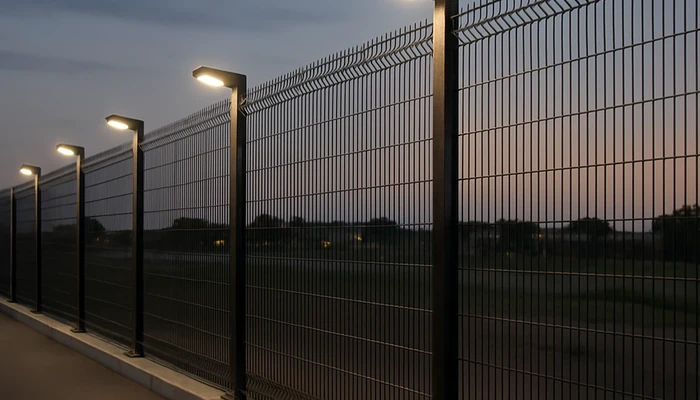
- Steel, Wrought Iron, or Aluminum: Strong, hard to climb, and enable good lighting with fewer blind spots.
- Wood and Vinyl Panels: Provide privacy but can cast deep shadows if lighting is not carefully planned.
- Mesh Fencing: Offers both visibility and some privacy; careful lighting design is still necessary to avoid glare and dark pockets.
For more on matching fence material to your security needs, see our guide on fence panel selection and overview of perimeter security.
Types of Security Lighting and Their Effects
Modern security lighting comes in several forms, each with unique pros and cons for perimeter safety when integrated with different fences.
| Lighting Type | Pros | Cons | Ideal For |
|---|---|---|---|
| Floodlights | Wide coverage, deters intruders | Can cause glare, harsh shadows | Open yards, tall fences |
| Spotlights | Focused, reduces light pollution | Potentially misses corners | Gate areas, entrances |
| Pathway lights | Safer walkways, low glare | Limited range | Yard & approach |
| Motion-activated | Energy efficient, alerts to movement | May startle, needs correct aiming | Driveways, near gates |
| Downlights | Reduces glare, focused downward | Requires placement planning | Above fence lines |
Downlighting—aiming lights downward from above the fence line—can dramatically reduce glare and prevent light trespass on neighboring properties, making it a favorite technique for privacy-minded Chicago homeowners.
Reducing Glare: Strategies for Comfortable Security
Too much brightness or poorly directed fixtures can cause direct glare, making it hard for people or cameras to see clearly. Here’s how to minimize glare without sacrificing safety:
- Use shielded fixtures: Fixtures with “cut-offs” restrict the angle of light, keeping it directed only where needed.
- Lower wattage bulbs: Gentle, consistent illumination is safer than harsh spotlights that create deep shadows.
- Proper mounting height: Position fixtures high enough to avoid shining directly into eyes or windows, but not so high that light is scattered by the fence.
- Horizontal spacing: Stagger lights along the fence line to ensure full coverage.
- Choose warm light colors: Cooler (blue) lights may cause more discomfort and glare; opt for warmer (yellow/orange) tones for residential areas.
For more on energy-efficient and glare-reducing options, explore the National Institute of Building Sciences security lighting guidelines.
Mitigating Blind Spots: Placement and Techniques
The key to eliminating blind spots is careful fixture placement relative to fence posts, corners, gates, and landscaping.
- Place lights at critical points: corners, gates, alleys, and near dense shrubbery.
- Angle lights to overlap beams, minimizing opportunities for anyone to slip through unlit spaces.
- Use multiple lower-output lights rather than relying on a single high-intensity floodlight.
- Regularly walk your yard at night to check for new shadow areas created by growing plants, parked vehicles, or changes in fence lines.
Chain link and mesh fences make it easier for light to reach every zone, but wooden and solid vinyl panels often require fixtures both inside and outside the perimeter to illuminate all possible approach routes.
Security Lighting and Fencing in Chicago: Codes and Practical Considerations
Homeowners in Chicago, Illinois often face specific requirements and climate concerns. Local codes may restrict fixture type, wattage, and even color temperature to minimize light pollution and neighbor complaints.
- Consult the WBDG guidelines and always check your local ordinances before installing new fixtures.
- Chicago winters can reduce bulb lifespans; choose fixtures rated for extreme cold.
- Consider snow buildup and ice, which can reflect light unpredictably and create new glare risks.
- Position controls and sensors where they will remain accessible year-round, avoiding areas prone to ice dams or heavy drifts.
For more in-depth perimeter planning related to codes and regulations, see our regulatory insights and perimeter security basics articles.
Integrating Fences, Security Lighting, and Surveillance Cameras
Proper collaboration between fences, lighting, and modern security cameras increases detection, deters intruders, and supports law enforcement if incidents occur. Key tips include:
- Minimize overlap of bright lights in camera fields to avoid washed-out footage.
- Angle lights away from camera lenses, using shields or baffles where necessary.
- Choose cameras with low-light or night-vision features for shadowed areas that lighting cannot fully cover.
- Update your system annually: new plant growth or fence repairs may open new blind spots.
To see how different fencing types support advanced security technologies, review our article on industrial fencing technologies.
Comparing Fence Types by Security Lighting Effectiveness
| Fence Type | Visibility | Glare Risk | Blind Spot Likelihood | Best Lighting Practices |
|---|---|---|---|---|
| Chain Link | High | Low | Minimal | Fewer lights, wide coverage |
| Wood Panel | Low | Medium | High | Staggered, dual-side lighting |
| Vinyl | Low | Medium-High | High | Shielded, soft fixtures |
| Iron/Steel | Medium | Low | Low | Downlighting, motion lights |
| Mesh | Medium-High | Low | Low | Evenly spaced, low-wattage |
Choosing the right fence material and planning lighting from the outset leads to the safest, most comfortable environment.
Common Mistakes and How to Avoid Them
- Over-lighting: More isn’t always better. Excess brightness reduces contrast and can annoy neighbors.
- Ignoring fence style: Solid fences without careful lighting create the most hidden areas.
- Placing lights too high or too low: Both can result in wasted energy and poor coverage.
- Skipping weatherproof fixtures: Chicago’s climate demands durable, sealed lighting solutions.
- Failing to update: Trees grow, fences age—lighting plans should adapt at least once a year.
For more fence-specific maintenance tips, visit our article on iron fence maintenance or our wood fence problem solving guide.
Frequently Asked Questions: Security Lighting & Fence Integration
- What is the most effective layout for security lighting and fencing?
A mix of fence-mounted downlights at critical points and pathway lighting facing approaches works best. Avoid over-illuminating one area while leaving corners or gates dark.
- How can I check for blind spots around my fence?
Walk your property at night with all lights on. Note where shadows fall and adjust lighting placement to reduce these areas.
- Does lighting reduce fence privacy?
Not if carefully aimed. Privacy fences can still block lines of sight if lighting is shielded and not aimed directly through windows or across yards.
- Are solar-powered lights reliable in Chicago’s climate?
Solar lights are viable, but must be rated for winter operation. Placement is critical to capture daytime sun in areas with heavy snowfall.
- What’s the best lighting type for chain link fences?
LED floodlights or motion-activated downlights offer great coverage and minimal glare due to the open fence design.
- Should my cameras and lights be connected?
Yes, pairing cameras with motion-activated lights improves response times and keeps both systems efficient.
- How can I minimize light pollution for neighbors?
Use fully shielded fixtures and position lights to avoid spillover beyond your property lines.
- Who should I contact to ensure my setup meets Chicago codes?
Consult a licensed local fence professional and review relevant lighting guidelines to make sure your project is compliant.
- Can fences and lighting help lower insurance rates?
They can—many insurers offer discounts for well-secured, well-lit properties. Speak with your provider for specific details.
- How often should I inspect my security lighting system?
At least once per season, and especially after storms or major changes in landscape or fencing.
Conclusion: Next Steps for Safe, Glare-Free Perimeters
Combining the right fence with smart security lighting is one of the simplest, most effective steps to protect your home or business. Taking time to choose proper materials, plan fixture placement, and reduce glare assures both peace of mind and good neighbor relations. Regular updates and seasonal checks are critical.
If you’re unsure where to start, contact Chicago Commercial Fencing for expert advice. To learn more about the details of different fence types or get inspiration, explore our fence selection resource or perimeter security guide.
Thinking about a new fence? Request a vinyl fence quote or explore wood fencing options to match your property’s needs.
About Chicago Commercial Fencing
Chicago Commercial Fencing is a professional fence company with over 15 years installing fences in the Chicago, Illinois area. The team serves homeowners, property managers, and businesses across the region, specializing in wood, vinyl, aluminum, chain link, and steel fencing for residential and commercial security. With clear advice, code-compliant work, and a transparent process, Chicago Commercial Fencing is fully licensed and insured, committed to lasting results for every project.
fence company in chicago, perimeter fence chicago, custom fence chicago, fence Morton Grove, fence repair Park Ridge, perimeter fence Washington, fence services Villa Park IL, Naperville fence, fence near Rivers Edge, fence Riverwoods
